
Trace minerals
Trace
minerals
Trace minerals (TM) play an important role in cattle immunity health and performance¹
Trace minerals are natural components of various enzymes and are involved in energy metabolism

Trace mineral levels affect neutrophil and macrophage function as well as the ability of lymphocytes to produce antibodies
Trace minerals are structural and functional components of key antioxidant enzymes: superoxide dismutases (SOD) and glutathione peroxidase (GPx)
Zn, Cu, Mn and Se play a critical role
in essential functions
Reproduction/Fertility
Spermatogenesis
Healthy Hooves
Healthy Hair/Skin
Cell Division
Reproduction/Fertility
Disease resistance
Hair color
Copper
Copper
Reproduction/Fertility
Ovulation
Spermatogenesis
Embryo survival
Heat stress
Reproduction/Fertility
Embryo survival
Retained placenta
Disease resistance
Selenium
Zn, Cu, Mn and Se play a critical role
in essential functions
Reproduction/Fertility
Spermatogenesis
Healthy Hooves
Healthy Hair/Skin
Cell Division
Reproduction/Fertility
Disease resistance
Hair color
Copper
Copper
Reproduction/Fertility
Ovulation
Spermatogenesis
Embryo survival
Heat stress
Reproduction/Fertility
Embryo survival
Retained placenta
Disease resistance
Selenium
The role of trace minerals within the immune system
is well recognised

Trace minerals (TM) play an important role in cattle immunity, health and performance¹
Trace minerals (TM) play an important role in cattle immunity, health and performance¹
Epithelial integrity
Leukocyte migration
Phagocytosis and bacteria killing
Cytokine production
Antibody secretion and cell-mediated
Immunity¹
Trace minerals are fundamental for enzymes involved in antioxidant protection against cellular damage and several pathways of the immune response¹.
Adequate TM supplementation should not only satisfy the basal requirements, but also provide a source of TM when there is a higher demand by the antioxidant systems or during the development of the immune response¹.
Zn, Cu, Mn and Se¹
by superoxide radicals
Lymphocyte proliferation
Enhances bactericidal ability
Cytokine production
Prevents leukocyte damage
by superoxide radicals
Enhances macrophage
killing ability
Modulates T cell and
B cell response
process through ceruloplasmin
Enhances neutrophil phagocytosis
and bacterial killing
Prevents leukocyte damage
by superoxide radicals
by superoxide radicals
Enhances neutrophil migration
Enhances bactericidal ability
Reduction of inflammation
Antibody production and
cell-mediated immunity
Zn, Cu, Mn and Se¹
by superoxide radicals
Lymphocyte proliferation
Enhances bactericidal ability
Cytokine production
Prevents leukocyte damage
by superoxide radicals
Enhances macrophage
killing ability
Modulates T cell and
B cell response
process through ceruloplasmin
Enhances neutrophil phagocytosis
and bacterial killing
Prevents leukocyte damage
by superoxide radicals
by superoxide radicals
Enhances neutrophil migration
Enhances bactericidal ability
Reduction of inflammation
Antibody production and
cell-mediated immunity
Oxidative stress
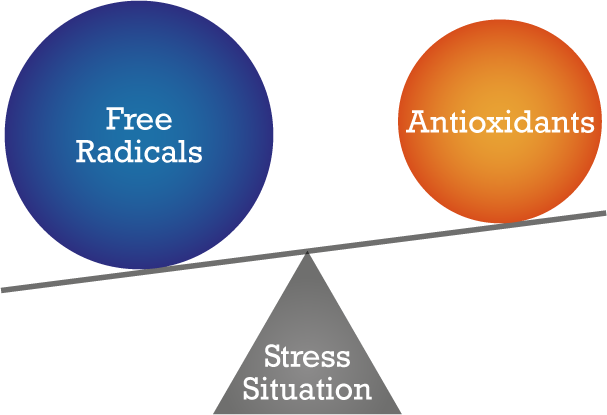
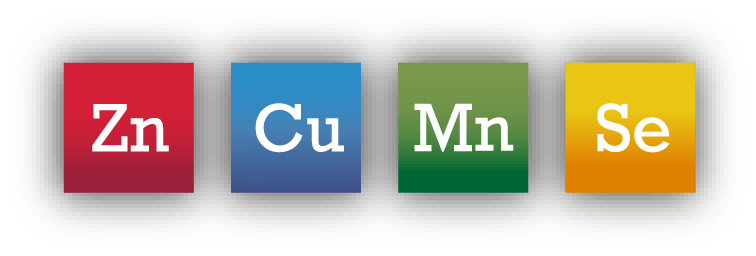
Zinc, Copper, Manganese and Selenium are structural components of the enzymes that neutralize ROS (superoxide dismutases and glutathione peroxidase).
Strategic supplementation with trace minerals can minimize the negative effects of stress on the immune system¹.
Oxidative stress
Oxidative stress is a term used to describe various deleterious processes resulting from an imbalance between excessive formation of ROS and/or reduced antioxidant defenses². (ROS = reactive oxygen species)
Disturbances in the balance between ROS production and antioxidant defenses can result in substantial damage to nearby tissues by oxidizing cellular lipids, proteins, and DNA³.
During the periparturient period the increase in metabolic activity results in an enhanced accumulation of ROS and the depletion of important antioxidant defenses.
The natural balance between ROS formation and antioxidant defense can be disrupted further by several other factors including:
NEFA= non-esterified fatty acids
Several studies have shown how oxidative stress is associated with:
Peripartum diseases such as instead of a retained placenta, metritis, mastitis, exacerbated
inflammation around calving⁴
Dystocia and prolonged calving⁵
Calf diarrhea prevalence and enterocyte damage⁶
Calf pneumonia⁷
References
1. Palomares, R. 2022. “Trace Minerals Supplementation with Great Impact on Beef Cattle Immunity and Health” Animals 12, no. 20: 2839.
2. Sies H. “Biochemistry of Oxidative Stress,” Angewandte, vol. 25, no. 12, pp. 1058–1071, 1986.
3. Sordillo L. 2013. “Review Article: Selenium-Dependent Regulation of Oxidative Stress and Immunity in Periparturient Dairy Cattle” Veterinary Medicine International, Volume 2013, Article ID 154045.
4. Abuelo A. et al., 2015. “The importance of the oxidative status of dairy cattle in the periparturient period: revisiting antioxidant supplementation” Journal of Animal Physiology and Animal Nutrition 99 (2015) 1003–1016.
5. Vannucchi C. et al., 2019. “Oxidative stress and acid-base balance during the transition period of newborn Holstein calves undergoing different calving times and obstetrical care” Journal of Dairy Science, Volume 102, Issue 2, February 2019, Pages 1542–1550.
6. Fu Z. et al., 2023. “Dynamics of oxidative stress and immune responses in neonatal calves during diarrhea” J. Dairy Sci. 107:1286–1298.
7. Özbek M., Özkan C., 2020. “Oxidative stress in calves with enzootic pneumonia” Turkish Journal of Veterinary & Animal Sciences, Vol. 44, No. 6, Article 17.